


In the world of BMX Flatland, NAO YOSHIDA has carved out a unique path beyond competition as an “artist.” He has performed on the stage of Cirque du Soleil, captivating audiences around the world as the only BMX performer across all 16 of its current productions.
As an artist, he has also gained attention in the art world through his original tire-painting technique known as “RIDRAWING,” as well as by handling BMX-related decorations for the opening ceremony of the 2024 Summer Olympics opening ceremony and providing works for various brands.
In this interview, he reflects on his journey from first discovering BMX to where he is today, and shares in depth how, as a rider, he found his own path of “expression” that ultimately led him onto the global stage.
NAO YOSHIDA (hereafter “N”)
The journey to the world stage — overcoming setbacks and pursuing a path once misunderstood as “walking two paths at once.”

— What first got you into BMX?
N: I started BMX when I was 15 years old. I wasn’t really the athletic type to begin with, and I wasn’t physically strong either, so I was more of an indoor kid who spent time playing video games and drawing at home. Once I got to junior high school, everyone around me started joining sports clubs, but I wasn’t very active, so I was just living a pretty laid-back school life. During that time, I started thinking, “I want to do something cool,” and that slightly rebellious, teenage feeling was really what sparked it all.
Back then, I used to watch the X Games on TV and read street-fashion magazines, which got me interested in BMX. I already liked riding bikes, and I used to do wheelies and drifts on regular bicycles. Then, when I was in my second year of junior high, my bike broke, and when it came time to buy a new one, I suddenly remembered, “Oh right, there’s BMX.” So I bought one online for around 30,000 yen.
My twin brother wanted one too, and when we started practicing together in front of our house, classmates gradually began joining us. At the time, there were barely any reference videos online, so we would look at frame-by-frame photos in magazines and how-to books, trying to figure out, “How do you even do this?” while practicing together.
— There really wasn’t much information available back then, was there?

N: Yeah. The internet existed, but there still weren’t many places where information was well organized like it is today. BMX was something you could barely even research back then. For a while, I couldn’t really do much beyond a few basic tricks. But once I got into high school, I started going to spots near the train station at night where older riders practiced, and they let me join them. It wasn’t really about being taught directly — I learned more by watching and copying.
— When did you start thinking seriously about becoming a professional?
N: Apparently, I wrote “I want to become a professional rider” in my junior high graduation booklet. But at the time, it was still vague — more like, “I want to get really good.” Even after entering high school, I kept practicing, but when it came time to think about my future, I struggled a lot. I also loved drawing, so I attended prep school aiming to get into an art university.
But art schools are extremely competitive, and many students spend extra years preparing for the entrance exams. Since I was trying to pursue BMX while studying for art school at the same time, people around me didn’t really look at it positively. I was often told, “You have to choose one or the other.”
In the end, I failed the entrance exams. After that, I completely lost motivation and eventually dropped out of high school. At the time, I really felt like I had hit rock bottom.

— How did things progress from there?
N: I worked part-time at a bike shop while competing in contests, and whenever I saved enough money, I would travel overseas. Around the age of 18, I started thinking, “The only way forward is to go abroad,” and at 19, I went to Londonfor the first time.I stayed for about two months and traveled around Europe, and during that trip, I ended up winning a competition in France. I had always admired overseas culture, so even though it was still in the amateur class, it became an incredibly important success experience for me.

— Was there a major turning point after that?
N: I won an award in an art competition in New York City, which gave me the opportunity to hold my own exhibition. At the time, I had applied pretty casually, so I never imagined I would actually win.
I suddenly had to book a ticket to New York, but I quickly ran out of money. To cover my living expenses, I started doing BMX street performances, but at first I barely made anything. However, through a lot of trial and error, more and more people gradually started gathering to watch, and eventually I was able to make a living from it.
That was the moment when I first became deeply conscious of creating performances meant to truly entertain and engage an audience.


The professional mindset he learned at Cirque du Soleil — turning even failure into art.

— After that, you also entered the world of stage performance, right?
N: Yes. At one point, I worked for Shiki Theatre Company in order to learn about the backstage side of live productions. I worked there for about three years, learning how shows are created and how they are delivered to audiences.
But during that time, I started questioning myself: “What is it that I really want to do?” While working late at night backstage, I realized, “I’m supposed to be performing on this stage myself.” That feeling became impossible to ignore, so I decided to leave that path behind and challenge myself once again as a performer.
— And that eventually led you onto the world stage.
N: Exactly. I was given an opportunity to join Cirque du Soleil. At first, it was only a one-month substitute performer contract. Since I was in a situation where I absolutely had to prove myself in such a short time, I gave it everything I had — not only in performance, but also in communication with the team.
Even when that one-month contract ended, I told everyone, “I’ll definitely be back, so take care of me until then!” I was completely serious about it.


As it turned out, the director really liked me, and I was eventually offered a two-year contract. It gave me the incredible experience of performing in over 300 shows a year in front of millions of people.
— Is there a particular mindset unique to performing in shows?
N: One of the first things I was told was, “Don’t show failure as failure.” In competition, mistakes are seen as negatives, but in a show, what matters is how you recover from them. For the audience, small mistakes aren’t nearly as important as the overall experience and impression.
That’s why I pay very close attention to my facial expressions as well. If you look visibly frustrated, the audience immediately recognizes it as a “mistake.” So I believe it’s important to fully become the role you’ve been entrusted with, including every aspect the audience can see.
Another thing is making sure the performance reaches even the person sitting in the very back row. Rather than focusing purely on trick difficulty, I place greater importance on expression, atmosphere, and the overall flow of the performance.

“RIDRAWING” — creating art with BMX tires. Expanding beyond competition into new forms of expression and unlocking new possibilities for BMX.
— I’ve heard that you also create music.
N: Music feels more like something I do because I don’t fully understand it yet. I started making music as a way to explore what kinds of rhythms naturally resonate with me and what kinds of sounds I’m drawn to.
Whether I’m riding BMX or creating artwork, I’m usually wearing earphones and listening to music, so I feel that what I’m listening to has a huge influence on my expression and creative work. When I start working on a project with a specific theme in mind, I think that if I can also create music that matches that same atmosphere myself, it brings an even stronger sense of consistency to the overall expression.

— Your style is really unique in the way you combine BMX not just as a sport, but with elements of music, art, and even contemporary dance.
N: My experience learning about production and creation behind the scenes of stage performances definitely had a big influence on me. But more than anything, I’ve always loved turning my emotions and thoughts into something tangible.
Today, BMX has become firmly established as a competitive sport, even becoming an Olympic Games discipline. I think that’s an amazing thing. But what originally attracted me wasn’t necessarily the competitive side — it was the artistic and cultural aspects that BMX possesses.
Competition is about earning points and ranking people, whereas art isn’t about competing at all; every form of expression has its own value. Right now, I feel like I’m experimenting with and exploring what can happen when BMX and art are combined together. It’s a theme I want to continue pursuing for the rest of my life.

— I think “RIDRAWING,” where you create art using BMX tires, symbolizes that spirit of exploration perfectly. What message are you hoping to convey through this work?
N: If I had to put it into one phrase, it would be “stepping outside the framework.” We all live, often unconsciously, within fixed ideas of how things are supposed to be. For example, riders usually think, “I don’t want to dirty my tires,” while painters might wonder, “Why use tires instead of a brush?”
I think there’s real meaning in deliberately challenging areas that nobody has explored before — spaces that feel unfamiliar or even uncomfortable from both perspectives. I want to value the mindset of, “If nobody’s seen it before, why not try it?”
— At the recent New Context Festival, your collaboration with beatboxing and the shamisen was also very striking.
N: With that stage, I wanted to express a kind of “future Japanese culture” — something that nobody had ever seen before, while still holding deep respect for traditional Japanese aesthetics and culture.
Together with people I truly trust, I feel we were able to present a completely new possibility.

— You’ve spent many years working internationally. How did you develop such a broad perspective?
N: Once I started going overseas, I realized just how rigid my own way of thinking had been. Things considered taboo in Japan could be appreciated elsewhere, and sometimes the opposite was true as well.
By communicating with all kinds of people not only through language, but also through “universal languages” like music and art, I became able to look at BMX from a much broader perspective.
The deeper you dive into what you truly love, the more you naturally connect with people across different fields and cultures. I think those experiences are what ultimately expanded my perspective.

— I heard that you recently performed to music by Ryuichi Sakamoto at a competition in Japan.
N: Yes. I intentionally entered a highly competitive contest with a contemporary-style showcase built entirely around musical interpretation and expression. I even made the costume myself and focused completely on synchronizing every movement to the music for the full three-minute performance.
In the end, I didn’t win the competition, but I believe I was able to make a statement about “expression” that goes beyond technical scoring alone.
At Cirque du Soleil as well, technical skill is simply the starting point. What they really ask is, “What is it that you want to express?” That sense of authorship and artistic identity is essential.
I want to continue pursuing the question of not just how advanced the technique is, but what lies beyond it — what you truly want to communicate through it.
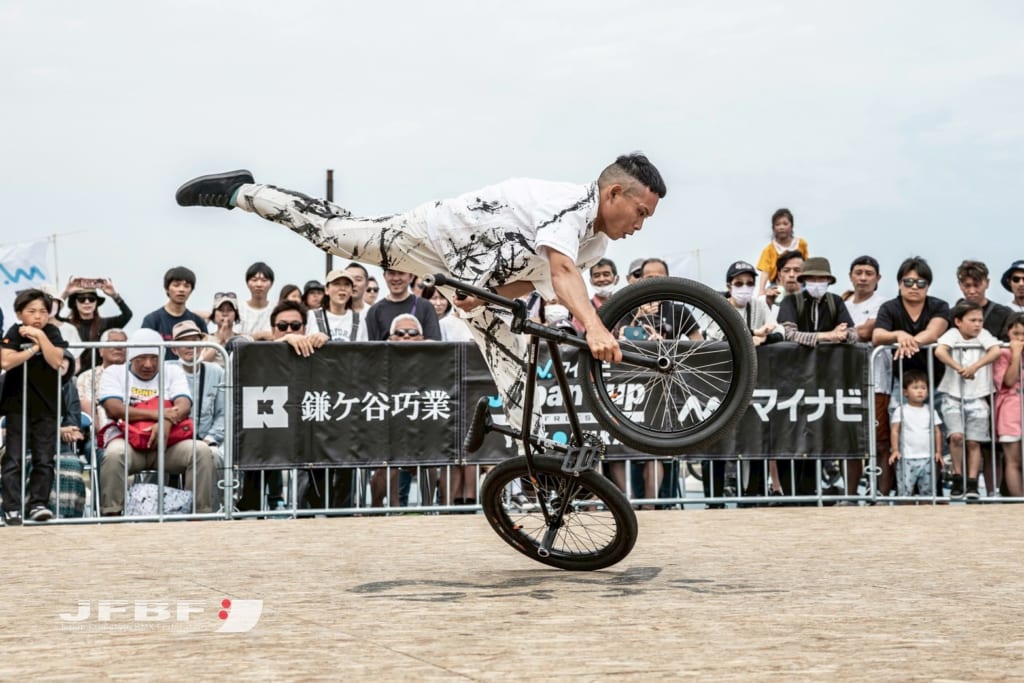
The future vision of NAO YOSHIDA — a one-of-a-kind artist continuing to perform on the world stage.
— Finally, could you share your future ambitions and a message for the next generation?
N: First of all, I want to continue valuing every day I spend with Cirque du Soleil. Out of all 16 current productions, the only show that features BMX is the one I’m part of. As the only person in the world holding that role, I want to continue sharing the appeal and artistic potential of BMX with audiences everywhere.
On the art side, I’ll also be holding an exhibition at a gallery in London in 2026. Ever since I first traveled abroad at 19, London has been a place I deeply admired, so this opportunity feels like a dream I’ve finally reached after nearly 20 years. Turning that vision into reality is the most important project in my life right now.
To the younger generation, I want to say this: don’t let yourself be swayed by the opinions around you — believe in what you think is cool and keep moving forward. Even if something feels like a failure in the moment, when you look back later, it often turns out to be far less significant than you thought.
I’ve personally been told many times by adults that “you’re doing it wrong” or “that’s not the way,” but by continuing to push forward, those choices eventually became what defines me today. Believe in yourself, and don’t be afraid to keep going.

